
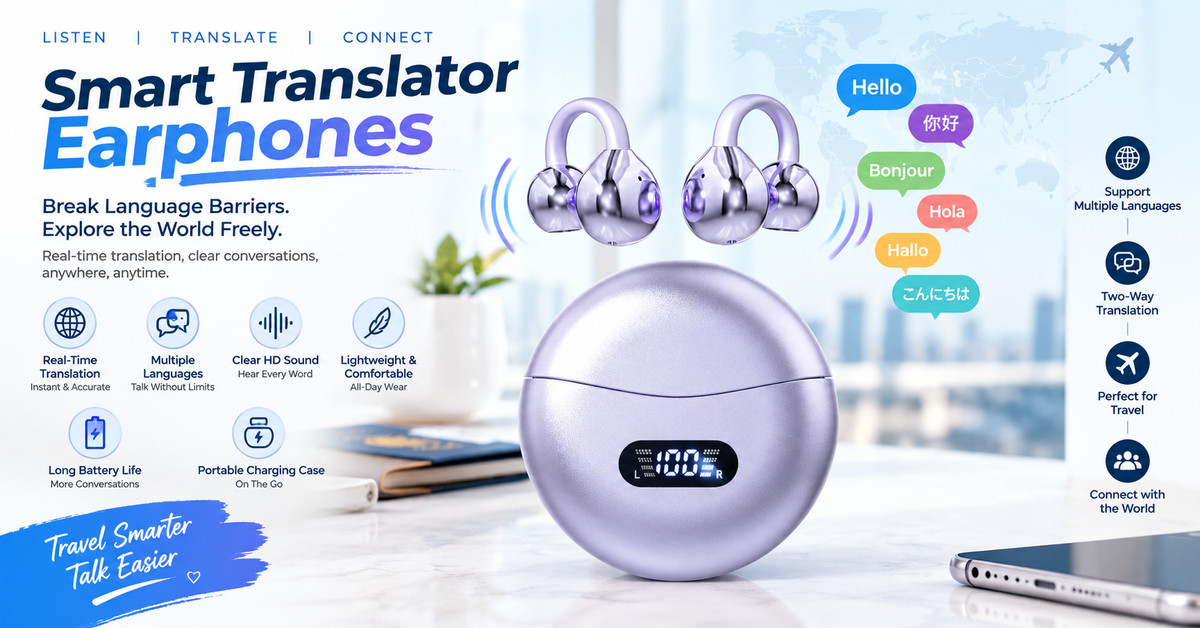
Imagine you are in a foreign city, ordering food, asking for directions, or negotiating with a local vendor. You pull out your phone, open a translation app, type or speak, wait, and then hand the phone back and forth. It works, but it is not smooth. This is exactly where Smart Translator Earphones are changing the game.
But are they really more convenient than a regular translation app on your phone? In this guide from TechAuraOnline, we compare both options on speed, accuracy, comfort, battery life, cost, and real-life use, so you can decide which one suits you best.
What Are Smart Translator Earphones?
Smart Translator Earphones are wireless earbuds with built-in or app-based real-time language translation. They pick up speech through microphones, translate it using AI, and play the translated version directly into your ear. Some models also let the other person hear your translated voice through your phone speaker or a second earbud.
Most Smart Translator Earphones connect to a smartphone app, support dozens of languages, and combine two functions in one device: normal earbuds for music and calls, and a personal interpreter for conversations.
What Is Phone Translation?
Phone translation means using an app such as Google Translate, Microsoft Translator, or the built-in translation tools on your device. You speak, type, or point your camera at text, and the app shows or reads out the translation.
Phone translation is free or very low cost, supports a huge number of languages, and works for text, voice, photos, and even offline use when language packs are downloaded. For many people, it is the first and only translation tool they ever use.
Smart Translator Earphones vs Phone Translation: Quick Comparison
|
Feature |
Smart Translator Earphones |
Phone Translation |
|
Hands-free use |
Yes |
No, you hold the phone |
|
Conversation flow |
Smoother, more natural |
Stop-and-start |
|
Cost |
Higher (extra device) |
Free or low cost |
|
Languages |
Fewer to moderate |
Very wide range |
|
Text and camera translation |
Limited |
Excellent |
|
Offline use |
Depends on model |
Available with downloads |
|
Extra battery to charge |
Yes |
No |
|
Best for |
Travel, meetings, long talks |
Quick lookups, signs, menus |
Convenience Test 1: Hands-Free Experience
This is where Smart Translator Earphones clearly win. Since the translation plays in your ear, your hands stay free. You can carry luggage, hold a map, shake hands, or take notes while the conversation continues.
With phone translation, you constantly hold the device, tap the microphone button, and pass it to the other person. In a short exchange this is fine. In a longer conversation, it becomes tiring and slows everything down.
Convenience Test 2: Natural Conversation
A real conversation depends on eye contact and rhythm. When you keep staring at a screen, the other person feels ignored, and the flow breaks.
Smart Translator Earphones let you look at the person while listening to the translation. Many models offer a mode where both people wear one earbud each, which feels almost like having a personal interpreter. This makes meetings, interviews, and casual talks feel far more natural.
Phone translation is still useful when both people are comfortable passing the phone around, but it creates a visible pause in every sentence.
Convenience Test 3: Accuracy and Reliability
Both options rely on AI translation, so accuracy is often similar. Common languages like English, Spanish, French, Hindi, and Chinese usually translate better than rare languages or heavy regional dialects.
Where they differ is the environment. Smart Translator Earphones depend on small microphones, so noisy streets, markets, or airports can reduce accuracy. Phone microphones are also affected by noise, but you can hold the phone closer to the speaker to improve results.
Phone translation also has an edge for reading text. Camera translation for menus, road signs, tickets, and documents is something most Smart Translator Earphones cannot do.
Convenience Test 4: Speed and Delay
Speed matters in conversation. Smart Translator Earphones usually deliver translation within a couple of seconds, though the delay depends on your internet connection and the language pair.
Phone apps also take a moment to process, and the manual steps (open app, choose language, tap mic) add extra time. In practice, Smart Translator Earphones feel faster once they are connected, because the process is already running in the background.
Convenience Test 5: Battery and Setup
Phone translation uses the battery you already have, and there is nothing extra to charge. That is a real advantage on long travel days.
Smart Translator Earphones need their own charging, and translation mode drains the battery faster than normal music playback. You also need to pair them, install an app, and sometimes update firmware. If you forget to charge them, they are useless as translators.
Convenience Test 6: Cost
Phone translation is free or cheap, and nearly everyone already has a smartphone. Smart Translator Earphones are an extra purchase. Prices vary widely, and some models also require a subscription or paid plan for certain languages or features.
If you travel rarely, spending extra money may not make sense. If you travel often or work with international clients, the cost can be worth it.
Convenience Test 7: Comfort and Everyday Use
Smart Translator Earphones double as regular earbuds. You can use them for music, calls, podcasts, and then switch to translation mode when needed. This makes them a two-in-one device.
Phone translation does not need anything to wear, which some people prefer. However, holding a phone in front of you during long conversations is simply less comfortable.
Scorecard: Which Is More Convenient Overall?
-
Smart Translator Earphones win: hands-free use, natural conversation, continuous talks, comfort for frequent users
-
Phone translation wins: cost, battery, language range, camera and text translation, offline flexibility
So the honest answer is that it depends on how you use translation. Neither option is perfect for everyone.
Who Should Buy Smart Translator Earphones?
Smart Translator Earphones are a great choice if you:
-
Travel often to countries where you do not speak the language
-
Attend international meetings, interviews, or business calls
-
Study or work in a multilingual environment
-
Want a hands-free, natural way to talk to people
-
Already need a good pair of wireless earbuds and want translation as a bonus
At TechAuraOnline, we suggest checking supported languages, battery life, and offline features before buying, because these three points decide whether the earphones will actually be useful for you.
Who Should Stick With Phone Translation?
Phone translation is enough if you:
-
Travel only once or twice a year
-
Mostly need to translate menus, signs, and short phrases
-
Want a free solution
-
Need support for rare languages
-
Do not want to carry or charge another device
Key Features to Check Before Buying Smart Translator Earphones
If you decide to buy, look for these features:
-
Language support: Make sure your required languages are included
-
Translation speed: Low delay makes conversation feel natural
-
Offline mode: Very helpful when roaming or when internet is weak
-
Battery life: Look for at least several hours of translation use plus a charging case
-
Noise reduction: Good microphones improve accuracy in busy places
-
App quality: A simple, stable app saves frustration
-
Comfort and fit: You may wear them for hours
-
Extra costs: Check whether subscriptions or paid language packs apply
Tips to Get Better Translation Results
-
Speak clearly and at a normal pace
-
Use short, simple sentences
-
Avoid slang and idioms, since AI often translates them incorrectly
-
Reduce background noise when possible
-
Download offline language packs before traveling
-
Keep your app and earphone firmware updated
-
Test your Smart Translator Earphones at home before your trip
Why Choose TechAuraOnline for Smart Translator Earphones Guidance?
Choosing between Smart Translator Earphones and a phone app is easier with practical advice. Here is why readers follow TechAuraOnline:
-
Simple and honest guidance: Features explained in easy language
-
Real-world focus: We look at daily use, not just box specifications
-
Compatibility-first advice: Language support, app quality, and device compatibility explained clearly
-
Easy comparisons: Side-by-side breakdowns so you can decide faster
-
Beginner-friendly content: No confusing jargon
-
Regularly updated tech tips: Useful information as new gadgets arrive
For more gadget comparisons and buying guides, visit TechAuraOnline.
Final Verdict
If you want the most convenient, hands-free, and natural conversation experience, Smart Translator Earphones are the better choice, especially for frequent travelers and professionals. If you need a free, flexible tool for menus, signs, and occasional conversations, phone translation is still hard to beat.
The smartest approach for many people is to use both: Smart Translator Earphones for live conversations, and the phone app for text, camera, and backup. For more honest comparisons and smart tech advice, keep following TechAuraOnline.
FAQs
1. What are Smart Translator Earphones?
They are wireless earbuds that translate speech between languages in real time, usually with the help of a smartphone app.
2. Are Smart Translator Earphones better than phone translation?
For hands-free, natural conversations, yes. For free use, text translation, and camera translation, phone apps are better.
3. Do Smart Translator Earphones work without internet?
Some models support offline translation for selected languages, but many need an internet connection. Check the specifications before buying.
4. How accurate are Smart Translator Earphones?
Accuracy is good for common languages and clear speech, but it can drop in noisy places or with slang, strong accents, and rare dialects.
5. Can I use Smart Translator Earphones as normal earbuds?
Yes. Most models work for music, calls, and videos as well as translation.
6. Is phone translation free?
Most popular translation apps are free, though some advanced features may be paid.
7. Which is better for travel: Smart Translator Earphones or a translation app?
Frequent travelers benefit from Smart Translator Earphones, while occasional travelers can manage with a free app.
8. Do Smart Translator Earphones need a subscription?
Some brands do charge for extra languages or features, so always check this before purchase.
9. Where can I find more guides on Smart Translator Earphones?
You can find simple, practical tech guides and comparisons on TechAuraOnline.